


The Recycled Material Fashion Revolution
Why the Ethical Fashion Movement Matters Right Now
The ethical fashion movement is a global push to make clothing more humane — for the people who make it, the planet it’s made on, and the animals affected along the way. Here’s a quick summary of what it means:
- What it is: A movement demanding fair wages, safe working conditions, and transparent supply chains in the fashion industry
- Why it matters: 93% of fashion brands don’t pay garment workers enough to live on, while the industry produces 100 billion garments every year — most of which end up as waste
- Who it involves: Workers, consumers, activists, nonprofits, and brands working together to push for systemic change
- What it asks of you: Shop more mindfully, support transparent brands, and reduce unnecessary consumption
The fashion industry is one of the most polluting and exploitative on Earth. It accounts for 2–8% of global greenhouse gas emissions — making it the third worst industry after food and construction. At the same time, clothing consumption has already climbed to 62 million tonnes annually, with projections pointing toward 102 million tonnes by 2030. Behind every garment is a human story — and too often, that story involves poverty, unsafe conditions, and broken promises.
This isn’t a niche concern. It’s one of the defining issues of our time.
At Salt Water Promise, we’re a coastal lifestyle brand rooted in the belief that what we wear can either harm or help the world around us — and we’ve built our mission around ocean conservation, responsible material choices, and genuine community action as part of the broader ethical fashion movement. As we explore the recycled material fashion revolution together, we’ll give you the tools to understand the industry, make better choices, and be part of the change.
Key terms for Ethical fashion movement:
Defining the Ethical Fashion Movement and Its Core Principles
When we talk about the ethical fashion movement, it’s easy to get it confused with “sustainable fashion.” While they are two sides of the same coin, they have different focuses. We like to think of them as the “People” vs. the “Planet.”
Sustainable fashion focuses on the environmental footprint — reducing CO2, saving water, and eliminating toxins. The ethical fashion movement, however, is rooted in social justice. It’s about the human beings behind the sewing machines. It asks: Are the workers safe? Are they being paid fairly? Is their dignity respected?
| Feature | Ethical Fashion | Sustainable Fashion |
|---|---|---|
| Primary Focus | Human rights and worker welfare | Environmental health and ecosystems |
| Key Issues | Fair wages, safe conditions, no child labor | Carbon footprint, water use, waste |
| Goal | Social justice and equity | Ecological balance and longevity |
At its heart, the movement is built on Scientific research on ethical foundations, which emphasizes that true sustainability cannot exist without ethics. We can’t call a shirt “eco-friendly” if it was made by someone working 18-hour days in a crumbling factory for pennies.
Human Rights and Worker Welfare in the Ethical Fashion Movement
The statistics are sobering. Currently, 93% of fashion brands do not pay garment workers a living wage. A living wage isn’t just a minimum wage; it’s enough to cover food, housing, healthcare, and education for a worker’s family. In many parts of the world, garment workers earn as little as 4 cents per garment produced.
Organizations like Remake – Ethically Fashionable are fighting to change this. They focus on three core pillars:
- Fair Labor: Ensuring every worker has a contract, fair hours, and a voice.
- Gender Equity: Since the majority of garment workers are women, the movement fights against systemic harassment and for equal pay.
- Safety: Moving away from the “sweatshop” model to ensure factories meet modern structural and fire safety standards.
We believe that transparency is the first step toward welfare. If a brand can’t tell us where their clothes were made, we have to ask ourselves what they might be hiding.
The History and Evolution of Fashion Activism
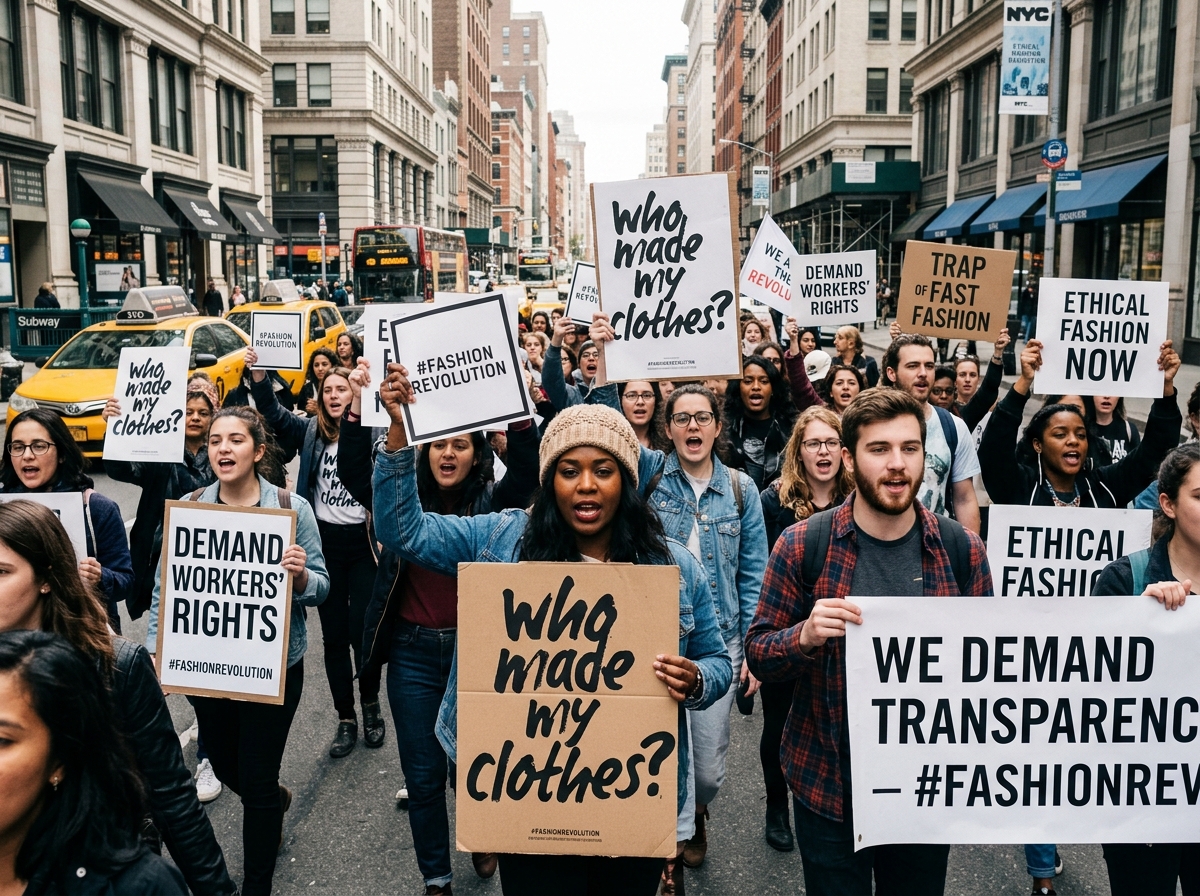
The ethical fashion movement didn’t appear overnight. It has evolved through decades of subcultures and tragedies that finally forced the world to look in the mirror.
- The 1970s: This was the start of awareness. Subcultures like hippies and punks began challenging mass consumerism. They favored second-hand clothes and natural fibers, viewing their wardrobe as a political statement against the “establishment.”
- The 1990s: The term “fast fashion” was coined as brands like Zara began producing styles at lightning speed. This era also saw the rise of organic cotton pioneers who realized the heavy chemical toll of traditional farming.
- The Turning Point (2013): On April 24, 2013, the Rana Plaza factory building in Bangladesh collapsed, killing 1,134 garment workers. It was the deadliest garment factory disaster in history and served as a global wake-up call. You can find more about this in History of sustainable fashion milestones.
Today, activism has moved from the streets to our smartphones, giving us the power to hold billion-dollar corporations accountable with a single hashtag.
Key Campaigns of the Ethical Fashion Movement
Campaigns are the engine of this movement. They turn our individual concern into collective power. Here are a few we actively support:
- Fashion Revolution Week: Held annually around the anniversary of Rana Plaza, this campaign encourages us to ask brands #WhoMadeMyClothes. Millions of people now participate, forcing brands to disclose their suppliers.
- The #NoNewClothes Challenge: Launched by Remake, this challenge asks us to pause all new purchases for 90 days. It’s a “reset” for our consumption habits, helping us realize we often have everything we need already.
- The Transparency Index: This is a vital resource. Each year, the Fashion Revolution Transparency Report ranks the world’s largest brands on how much they reveal about their climate and labor policies.
These campaigns prove that while one person’s choice matters, our collective voice is what actually changes laws and corporate behavior.
How to Transition from Fast Fashion to Circular Models
Fast fashion is designed to be disposable. It’s a “linear” model: take resources, make a cheap shirt, wear it twice, and throw it away. This model is responsible for over 6 million tons of greenhouse gases annually from single brands alone.
The alternative is Circular Fashion. In a circular model, waste is designed out of the system. Instead of a landfill, a garment’s journey looks like this:
- Design for Longevity: Making clothes that last for years, not weeks.
- Repair and Upcycle: Fixing a tear or turning an old pair of jeans into a tote bag.
- Resale and Rental: Giving clothes a second or third life with a new owner.
- Recycle: Turning old fibers into new yarn.
Transitioning away from fast fashion doesn’t mean you have to stop loving style. It means moving toward Slow Fashion — a market that values quality over quantity and supports local artisans who use traditional, low-impact techniques.
Embracing Recycled Materials and Bio-textiles
A huge part of the ethical fashion movement is rethinking what our clothes are made of. Did you know that 34.8% of microplastics found in our oceans come from synthetic textiles? Every time we wash a cheap polyester shirt, thousands of tiny plastic fibers go down the drain and into the sea.
We are seeing a revolution in material science to solve this:
- Recycled Polyester: Using plastic bottles or “ghost” fishing nets pulled from the ocean to create durable beachwear.
- Mushroom Leather: Scientific research on mushroom leather shows that we can grow leather-like materials from fungi (mycelium) in a matter of weeks without the environmental toll of cattle ranching.
- Bacterial Cellulose: Scientists are even “growing” textiles using SCOBY (the same stuff in kombucha!) to create biodegradable fabrics.
By choosing recycled and bio-based materials, we’re not just reducing waste; we’re actively cleaning up the environments we love.
Overcoming Challenges: Greenwashing and Accessibility
As the ethical fashion movement grows, so do the obstacles. The biggest one? Greenwashing. This is when a brand spends more money on marketing themselves as “eco-friendly” than they do on actually being sustainable. They might use a green leaf on a tag or release one “conscious” collection while the other 99% of their production remains exploitative.
You can dive deeper into this in the Research on greenwashing in the new millennium. To spot greenwashing, look for specific data. If a brand says they are “working toward” fair wages but doesn’t provide a timeline or a report, be skeptical.
Another challenge is Accessibility. Ethical clothes often cost more because the people making them are actually being paid. This can create a “systemic injustice” where only wealthy people can afford to shop their values. However, the movement is working to change this by promoting thrifting, clothing swaps, and mending — which are the most ethical (and affordable) ways to dress!
Frequently Asked Questions about Ethical Fashion
What is the difference between ethical and sustainable fashion?
Ethical fashion focuses on the social side (human rights, fair pay, safe conditions), while sustainable fashion focuses on the environmental side (low carbon footprint, non-toxic dyes, water conservation). Both are necessary for a better industry!
How can I tell if a brand is truly ethical?
Check for third-party certifications like Fair Trade, GOTS (Global Organic Textile Standard), or B Corp status. You can also look up the brand on the Fashion Transparency Index or use apps like Good On You to see their ratings.
Is the ethical fashion movement making a real impact?
Yes! Since 2013, we’ve seen major policy changes, like the International Accord for Health and Safety in the Textile and Garment Industry. Brands are also seeing declining stocks when they are exposed for unethical practices, proving that consumer pressure works.
Conclusion: Joining the Global Shift Toward Conscious Style
At Salt Water Promise, we know that the ocean doesn’t have a voice, and neither do many of the workers in the global fashion supply chain. That’s why we use our platform to speak up. Whether we’re advocating for clean beaches or choosing recycled materials for our coastal apparel, we are committed to being part of the ethical fashion movement.
The future of fashion isn’t about more; it’s about better. It’s about innovation in bio-textiles, stronger policies to protect workers, and a global community of people who care about the “promise” they make when they get dressed in the morning.
We believe that small, consistent actions lead to powerful collective impact. By choosing to mend, thrift, or support transparent brands, you are helping to preserve the marine life and coastlines that shape our way of life.
Wear the wave. Be the change.
Ready to make a difference? Shop our collection and join us in protecting our oceans, one garment at a time.


