


Making a Splash for Marine Life Protection
Why Ocean Conservation Efforts Matter More Than Ever
Ocean conservation efforts are the actions, policies, and programs working to protect marine ecosystems from threats like plastic pollution, overfishing, climate change, and biodiversity loss. Here’s a quick snapshot of where things stand:
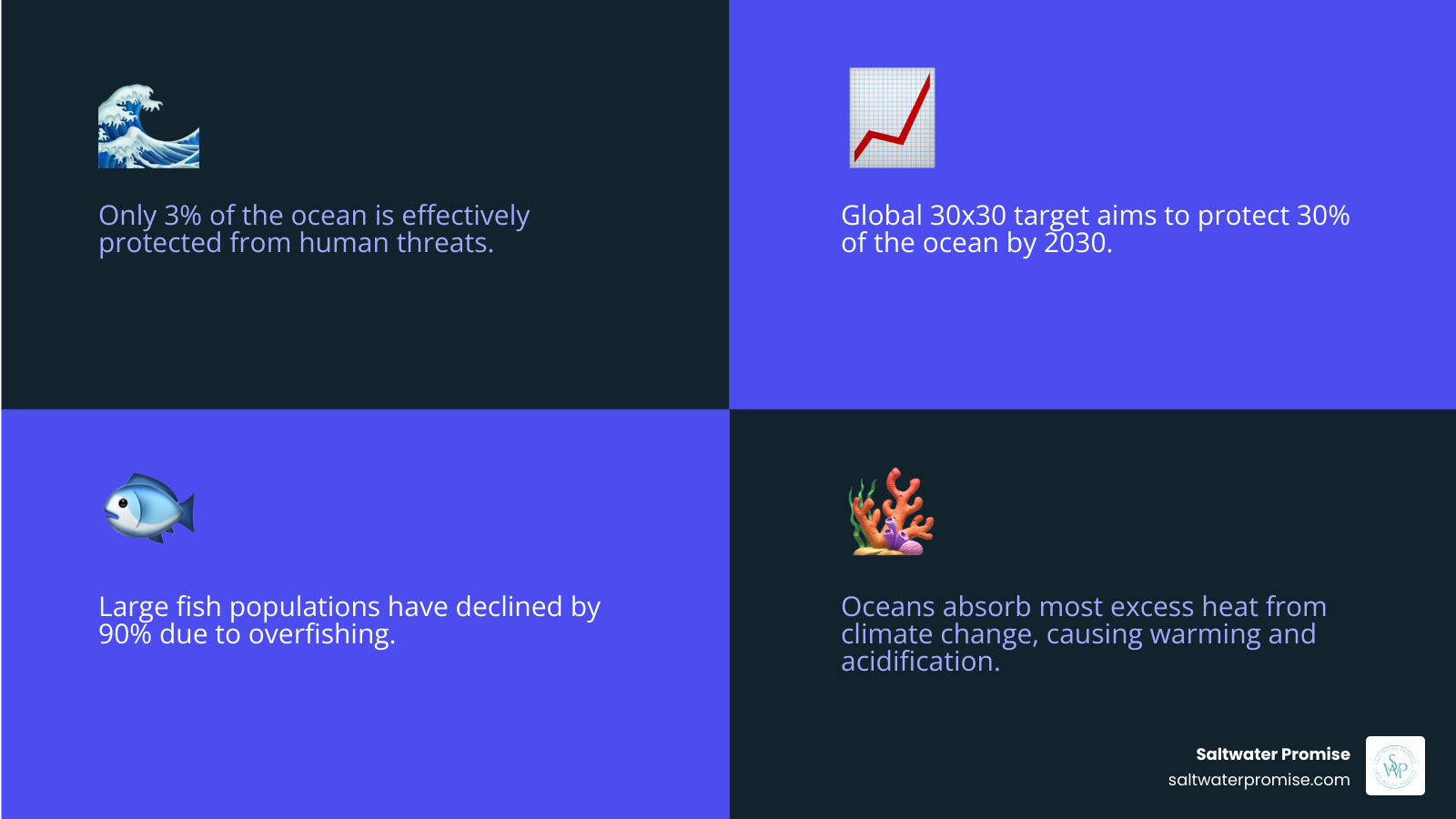
- Only ~3% of the ocean is effectively protected today
- The global target is to protect at least 30% of the ocean by 2030 (the “30×30” goal)
- Key threats include plastic pollution, overfishing, ocean warming, acidification, and habitat destruction
- Leading organizations like Oceana, Ocean Conservancy, and Marine Conservation Institute are driving measurable progress
- You can help through sustainable seafood choices, reducing plastic use, supporting cleanups, and backing ocean-focused advocacy
The ocean isn’t just a beautiful backdrop. It produces over half the oxygen we breathe, absorbs most of the excess heat trapped by climate change, and supports billions of people for food and livelihoods. Yet the very systems keeping it alive are under serious strain. Large fish populations have dropped by 90 percent due to overfishing alone. Plastic and other trash continue to pile up in our waters. And warming temperatures are pushing coral reefs and marine species toward the edge.
The gap between where we are and where we need to be is real — but so is the momentum to close it.
At Saltwater Promise, we’re a coastal lifestyle brand rooted in Indian Rocks Beach, Florida, built on the belief that the beach gives us everything and we owe it something back — making ocean conservation efforts a core part of everything we do. From beach cleanups to partnering with ocean-focused organizations, we’re here to help you turn that love for the coast into meaningful action.
Terms related to Ocean conservation efforts:
The Global Race to 30×30: Scaling Ocean Conservation Efforts
The “30×30” target is perhaps the most ambitious rallying cry in the history of marine science. The goal is simple but daunting: protect at least 30% of the world’s ocean by the year 2030. Why 30%? Scientists agree this is the minimum threshold required to safeguard marine biodiversity, support fisheries, and build resilience against a changing climate.
Currently, we are facing a significant gap. While many maps show large swaths of blue labeled as “protected,” the reality is that only about 3% of the global ocean is under effective protection—meaning the rules are strong enough to actually allow nature to recover. To bridge this gap, we need to move fast.
Tools like the Visit MPAtlas to track global progress are essential in this race. Developed by the Marine Conservation Institute, MPAtlas provides a transparent, science-based perspective on which areas are truly protected and which are “paper parks” with little to no actual management. Complementing this is the Blue Parks initiative, which sets a high bar for conservation excellence, awarding sites that meet rigorous scientific standards for effectiveness.
Nations are stepping up to meet these milestones. For instance, Conserving Canada’s oceans by 2030 is a top priority for the Canadian government, which has already reached approximately 15.54% protection. Similarly, the California Roadmap is a localized powerhouse of policy, aiming to protect an additional 275,000 acres of coastal waters. These efforts aren’t just about government mandates; they increasingly rely on Indigenous stewardship. In places like the Melanesian Ocean Reserve and various Canadian marine refuges, Indigenous-led conservation ensures that traditional wisdom and modern science work hand-in-hand to protect “Earth’s blue heart.”

Confronting the Four Pillars of Marine Degradation
To understand why Ocean conservation efforts are so critical, we have to look at the primary threats facing our waters. We often view these as separate issues, but they are deeply interconnected.
- Plastic Pollution: The numbers are staggering. Organizations like Ocean Conservancy have mobilized 19 million volunteers to remove over 400 million pounds of plastic and trash from beaches and waterways. Plastic doesn’t just look ugly; it’s lethal. A landmark study recently explored the specific “lethal doses” of plastic ingestion for marine animals. Even “ghost gear”—lost or abandoned fishing nets—continues to “fish” long after humans have left, entangling turtles, dolphins, and whales.
- Overfishing: We have taken too much, too fast. Stocks of large predatory fish have declined by 90% over the last century. When these top predators disappear, the entire food web collapses.
- Climate Change and Acidification: The ocean is our greatest climate ally, absorbing 90% of the excess heat generated by human activity. However, this comes at a cost. Warming waters cause coral bleaching, while the absorption of CO2 leads to acidification, making it harder for shellfish and corals to build their skeletons.
- Habitat Destruction: From bottom trawling to industrial development, we are losing the nurseries of the sea. Reports on how Offshore Drilling and the Climate Crisis go hand-in-hand show that extracting fossil fuels from the seabed not only risks catastrophic spills but also fuels the very warming that destroys marine life.
Innovative Tools for Tracking Ocean Conservation Efforts
We can’t manage what we can’t measure. That’s why data-driven tools are the backbone of modern Ocean conservation efforts. The MPAtlas allows us to see the quality of protection globally, ensuring that 30×30 becomes a reality of substance, not just a statistic on a page.
Discovery is also evolving. Did you know that over 90% of marine species remain undiscovered? The Ocean Census Biodiversity Data Platform is changing that. By uniting over 1,200 scientists, this initiative uses high-resolution imaging and genetic barcoding to accelerate the discovery of life underwater. In just a short time, they have identified over 900 new species—from deep-sea isopods to vibrant sea pens. Every new species discovered is a new reason to protect its habitat.
Economic and Ecological Benefits of Ocean Conservation
Conservation isn’t just about “saving the fish”—it’s about saving ourselves. A healthy ocean is the foundation of a “Blue Economy.”
- Climate Resilience: Mangroves and seagrasses act as natural storm buffers, protecting coastal communities.
- Job Creation: Sustainable aquaculture and eco-tourism provide millions of jobs worldwide.
- Food Security: By restoring fish populations, we ensure a sustainable protein source for a growing global population.
- Human Protection: Conservation efforts aim to protect 100 million people currently at severe risk from climate-related emergencies.
From High Seas to Coastal Waters: Policy and Victories
For a long time, the “High Seas”—the vast areas of ocean beyond national borders—were a lawless frontier. That changed with the BBNJ Agreement (Biodiversity Beyond National Jurisdiction), also known as the High Seas Treaty. This historic agreement provides a legal framework to establish marine protected areas in international waters, covering nearly half the planet’s surface.
On the national level, organizations like Oceana have been winning major battles. With over 325 victories, they have helped protect more than 4 million square miles of ocean. This includes advocating for the Urgent Action for Marine Mammals to ensure the Marine Mammal Protection Act is fully funded and enforced.
Indigenous leadership is also redefining what “large-scale” looks like. The Melanesian Ocean Reserve spans 6 million square kilometers—an area as vast as the Amazon rainforest. This is the first multi-national, Indigenous-led reserve on Earth, rooted in customary governance and ancestral wisdom. Similarly, Mission Blue’s “Hope Spots” identify critical areas that, if protected, could provide a “seed bank” for the rest of the ocean.
Turning Awareness into Action: How Individuals Can Help
It’s easy to feel small when looking at a map of the Pacific, but individual actions are the ripples that create a wave of change. At Saltwater Promise, we believe that everyday choices are the most powerful tools we have.
- Choose Sustainable Seafood: Most fisheries are fully fished or overfished. By choosing seafood that is caught or farmed responsibly, you take the pressure off vulnerable species. This is especially important given recent Seafood Fraud Analysis showing that many consumers aren’t getting what they paid for.
- Reduce Plastic Use: Every pound of plastic you don’t use is a pound that won’t end up in a sea turtle’s stomach.
- Join a Cleanup: Whether it’s a local event in Indian Rocks Beach or a global initiative, beach-clean-up-initiatives are vital for immediate habitat improvement.
- Vote with Your Wallet: Support brands that prioritize the planet. Choosing ocean-friendly-clothing made from eco-conscious materials ensures your style doesn’t come at the cost of the coast.
Supporting Global Ocean Conservation Efforts Through Advocacy
Advocacy is about using your voice to influence the “big picture.” You can Join Team Ocean to mobilize with other fans of the sea or provide financial support through Donate to Ocean Conservancy.
Many smaller conservation projects also rely on fiscal sponsorship. This allows independent researchers and community leaders to get their projects off the ground without needing to form their own non-profit. From tracking sawfish to restoring kelp forests, these community-led projects are where the “boots on the ground” (or fins in the water) work happens.
Behavior Change Strategies for Lasting Impact
Why do we know the ocean is in trouble but sometimes fail to act? This is called the “awareness-to-action gap.” Modern Ocean conservation efforts now use behavioral science to bridge this gap.
- Social Marketing: Making sustainable choices the “cool” and easy thing to do.
- Access to Nature: Programs like “Critter Scholars” provide underserved urban youth with their first ocean experiences, fostering a lifelong love for conservation.
- Sustainable Travel: Eco-travel trips aren’t just vacations; they are educational immersions that shift the industry toward higher environmental standards.
Frequently Asked Questions about Marine Protection
What is the 30×30 target?
It is a global commitment by nations to protect at least 30% of the world’s land and ocean by 2030. This target is considered the “gold standard” for preventing mass extinction and ensuring the ocean remains a functional climate regulator.
How much of the ocean is currently protected?
While about 8% of the ocean has some form of designation, only about 3% is effectively and highly protected from extractive activities. Some regions are doing better; for example, Canada has reached 15.54% and California is at 21.9% of its coastal waters.
How can I contribute to ocean conservation daily?
Start by reducing single-use plastics and checking your seafood against sustainability guides. You can also support local beach-clean-up-initiatives and use your social platform to spread awareness about marine protection.
Conclusion
The ocean is resilient, but it isn’t invincible. The Ocean conservation efforts we support today will determine the state of the world our children inherit. Whether it’s through massive international treaties like the High Seas Treaty or the simple act of picking up a piece of trash on your morning walk, every action counts.
At Saltwater Promise, we invite you to “Wear the Wave” and “Be the Change.” Our mission is to turn the love we all have for the sea into a legacy of protection. By choosing purpose-driven apparel and supporting community action, you aren’t just a consumer—you’re a steward of the blue planet.
Ready to make your own promise to the sea? Shop to support a healthy ocean and a thriving planet and join us in protecting the places we love most.


