


Living on the Horizon: A Reflection on Coastal Existence
Where Two Worlds Converge
Where land meets sea is more than a geographical location—it’s a dynamic zone with multiple meanings:
- Scientifically: A transitional ecosystem (intertidal zone, coastal wetlands, mangrove forests) where terrestrial and marine processes intersect
- Legally: A defined boundary establishing territorial seas, typically measured from baselines along the coast (12 nautical miles under international law)
- Ecologically: A critical habitat supporting juvenile fish, migratory birds, coral reefs, and serving as natural storm protection
- Artistically: A powerful symbol of transition, change, and the meeting of different states of being
- Commonly called: Coast, shore, shoreline, or coastline
The ocean covers 72% of Earth’s surface, and most of us live within 200 miles of it. Yet the narrow band where waves meet sand—where land meets sea—holds outsized importance for both human communities and the natural world. It’s a place of constant negotiation: tides advance and retreat, sediments shift, ecosystems adapt, and human activities press ever closer to the water’s edge.
This interface is simultaneously a scientific marvel, a legal boundary, an artistic inspiration, and a personal refuge. It’s where mangrove roots create nurseries for 90% of commercially valuable sea life. It’s where international law draws invisible lines 12 nautical miles out to define a nation’s territorial waters. It’s where artists like Damien Hirst capture the raw power of winter waves, and where families build sandcastles and collect shells.
But this horizon is under pressure. Nearly half the world’s mangrove forests are destroyed or in poor condition. Coastal communities face rising seas, more powerful storms, and the accumulated impacts of development, pollution, and climate change. The resilience of these systems—and the communities that depend on them—requires understanding, respect, and action.
As Salt Water Promise, a coastal lifestyle brand born on the shores of Indian Rocks Beach, Florida, we’ve witnessed the beauty and fragility of where land meets sea. Our mission is rooted in protecting this precious boundary through education, community action, and products that reflect our commitment to the coast.
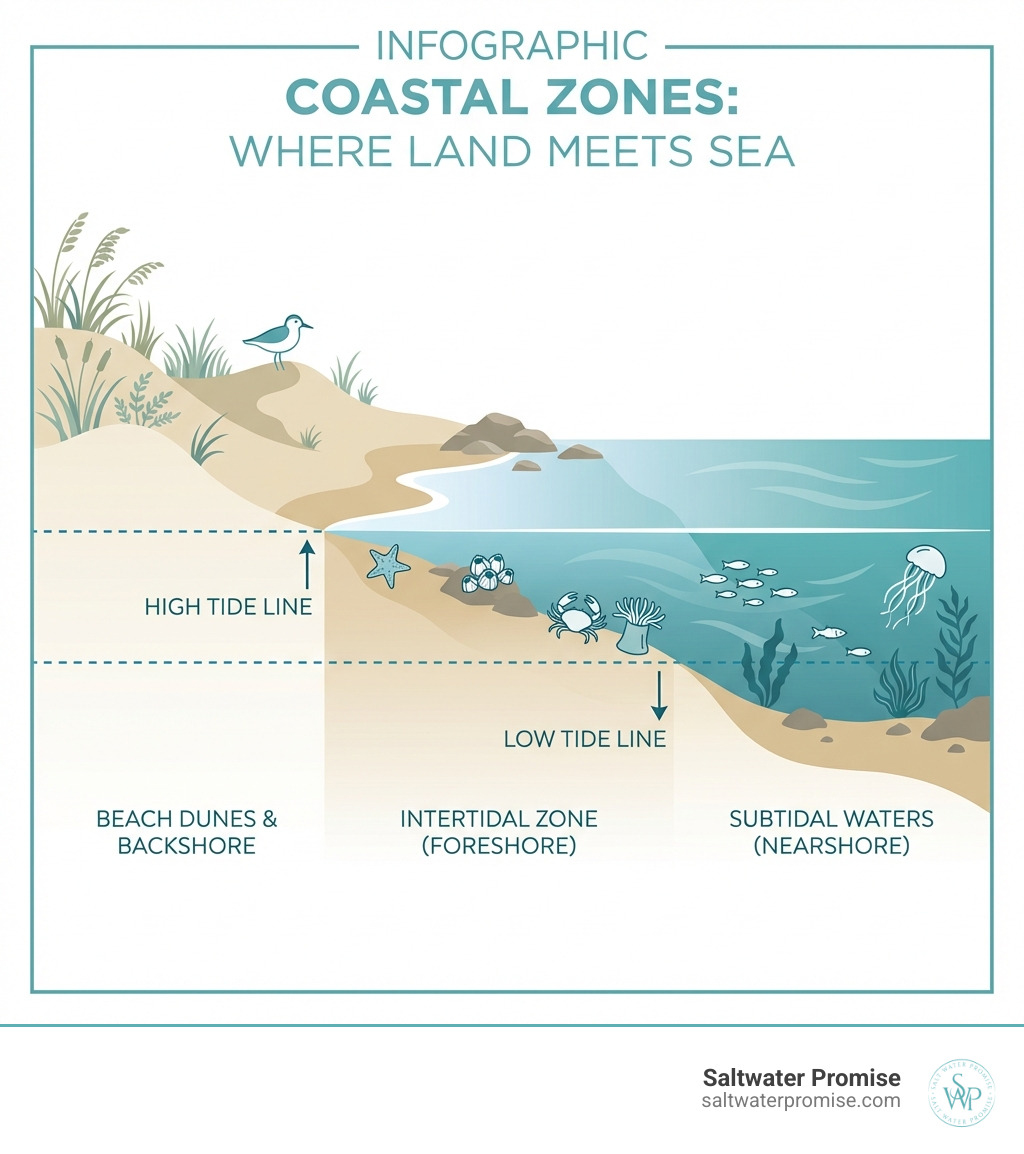
Where land meets sea terms to learn:
The Shifting Line: A Boundary of Science, Law, and Art
The concept of where land meets sea is far from static. It’s a dynamic boundary, constantly redefined by natural forces, human constructs, and imaginative interpretations. This section explores the multifaceted ways we define the coastline, from a dynamic ecosystem to a legal border and an artistic inspiration.
The Scientific Definition: A Dynamic Ecological Zone
From a scientific perspective, where land meets sea is a vibrant, ever-changing ecological zone. It’s a critical interface where terrestrial, freshwater, and oceanic processes converge, creating unique habitats that support incredible biodiversity and provide essential services to both nature and humanity.
Our coasts are incredibly diverse, ranging from sandy beaches and rocky shores to expansive salt marshes, intricate coral reefs, and dense mangrove forests. These coastal ecosystems are not just picturesque landscapes; they are dynamic zones that serve as critical transition points for countless species throughout their life cycles. For instance, saltwater marshes often function as nurseries for juvenile marine fish and provide vital habitats for shorebirds and waterfowl. Similarly, coral reefs offer shelter for small fish and crucial food sources for larger marine life, while seagrass beds provide essential nursery habitats for young fish.
Mangrove forests, in particular, are mystical, tangled jungle gyms of roots and branches that are crucial for both terrestrial and marine life. They act as nurseries for juvenile fish and invertebrates, providing safety from predators and a place to hide and hunt. These intricate ecosystems are so vital that up to 90 percent of commercially valuable sea life depends on them for some stage of their life cycle. Beyond their role as nurseries, mangroves also act as natural buffers, protecting shorelines from erosion caused by major storms and hurricanes due to their complex root structures that anchor them in shifting sediments.
However, these vital ecosystems are under immense pressure. Scientists estimate that nearly half the world’s mangroves are either destroyed or in dangerously poor condition due to unsustainable land development, pollution, clearing for agricultural use, and climate change. Increased global tourism also drives demand for coastal development, further encroaching on these delicate habitats.
Understanding these complex interactions is paramount for effective management. Scientific research helps us refine our understanding of how coastal systems respond to stressors, quantify energy and nutrient flows, and assess the impacts of human activities. This knowledge is translated into strategies for coastal communities to adapt to changing coasts, inform coastal engineering decisions, and prepare for impacts associated with current and future coastal hazards. We believe that engaging with at-risk communities on the best ways to manage, protect, and restore coastal wildlife and ecosystems is a shared responsibility. The U.S. Geological Survey (USGS) plays a critical role in supporting this effective, science-based management of coastal ecosystems, providing managers with the information they need to make sound decisions through cutting-edge research, predictive modeling, and decision-support tools. Their work helps us all appreciate and protect the intricate balance of where land meets sea: USGS science for resilient coastal habitats.
The Legal Boundary: Defining Nations Where Land Meets the Sea
Beyond its ecological significance, where land meets sea also represents a crucial legal and political boundary. The “law of the sea” is a comprehensive body of customs, treaties, and international agreements by which governments maintain order, productivity, and peaceful relations on the sea. This framework defines national jurisdictions, regulates resource management, and ensures safe navigation.
The cornerstone of this framework is the United Nations Convention on the Law of the Sea (UNCLOS), adopted in 1982. Often called the “constitution for the oceans,” UNCLOS comprises 320 articles and nine annexes, setting out the legal framework for all activities in the oceans and seas. It defines various maritime zones, each with distinct rights and responsibilities for coastal states:
- Territorial Sea: Every state has the right to establish the breadth of its territorial sea up to a limit not exceeding 12 nautical miles from its baselines. Within this zone, the coastal state exercises full sovereignty, extending to the airspace above, the seabed below, and its subsoil. However, this sovereignty is subject to the right of “innocent passage” for foreign vessels.
- Contiguous Zone: This zone may extend up to 24 nautical miles from the baselines. Here, the coastal state can exercise control to prevent infringement of its customs, fiscal, immigration, or sanitary laws and regulations within its territory or territorial sea.
- Exclusive Economic Zone (EEZ): Extending up to 200 nautical miles from the baselines, the EEZ grants the coastal state sovereign rights for exploring, exploiting, conserving, and managing natural resources, both living and non-living, of the waters superjacent to the seabed and of the seabed and its subsoil. It also provides jurisdiction over artificial islands, marine scientific research, and environmental protection.
Defining these boundaries precisely is a complex task. Organizations like NOAA (National Oceanic and Atmospheric Administration) are responsible for depicting these limits on nautical charts. The “normal baseline” from which these zones are measured is typically the low-water line along the coast as marked on officially recognized, large-scale charts. These baselines are often “ambulatory,” meaning they are subject to changes from natural processes like accretion (land addition) and erosion, which can shift a nation’s maritime zones accordingly. The United States recognizes that the 1982 Convention reflects customary international law and complies with its provisions, underscoring the global importance of these definitions. For a deeper dive into these legal definitions, we can explore what is the law of the sea?.
The Artistic Interpretation: Capturing the In-Between
Beyond the scientific and legal definitions, where land meets sea has long served as a profound source of inspiration for artists, writers, and filmmakers. It’s a place that evokes powerful emotions, symbolizes transition, and captures the raw beauty and impermanence of the natural world.
Consider the works of Damien Hirst, whose recent exhibition “Where the Land Meets the Sea” showcased his “Coast Paintings,” “Sea Paintings,” and “Seascapes.” Hirst’s inspiration stemmed from his childhood holidays spent in British seaside towns, where witnessing the powerful action of crashing waves in winter instilled in him a feeling of unimportance and vastness. This experience, he reflects, brought an awareness that everything will eventually wear out to nothing. His “Sea Paintings” were an attempt to perfectly recreate photographs in paint, a practice he calls “Fact Paintings,” while his “Seascapes” combined photorealistic imagery with expressionistic splatters, often in greyscale tones, reflecting the temperament of British coastlines during winter. Hirst’s art captures the untamed power of the ocean and its capacity to evoke deep philosophical reflections on existence and decay.
Similarly, Clare Leighton’s classic book, “Where Land Meets Sea: The Enduring Cape Cod,” offers a historical perspective on this artistic fascination. Published in 1954, the book was praised for its “stunning” illustrations—stark woodblock prints and engravings—that accompanied entertaining text. Described as a “tone poem, a hymn of praise” by The New York Times, Leighton’s work used art to explore specific coastal landscapes, sharing “great thoughts and stories” about the area and capturing its unique essence. Her engravings alone were said to tell the story, highlighting the visual power of the land-sea interface.
Even in film, the phrase resonates. “Where The Land Meets The Sea” (2016) is a coming-of-age film that explores themes of struggle to redefine oneself as an adult, sisterhood, independence, and partnership. The title itself suggests a metaphorical space of transition and change, mirroring the physical boundary it describes.
These artistic interpretations, whether through painting, engraving, or film, consistently highlight the symbolic power of where land meets sea as a space of connection, transition, and profound natural beauty. It’s a place where the grandeur of nature meets the human experience, inspiring reflection on our place in the world and the enduring power of the elements.
A Crucible of Life: The Ecological Heart of the Coast
Where land meets sea is not merely a boundary; it is a vibrant crucible of life, a dynamic and fertile zone teeming with biodiversity and performing critical ecological functions. It is the ecological heart of the coast, supporting an intricate web of life that sustains both marine and terrestrial environments.

Jean-Michel Cousteau eloquently describes this zone as a “place of amazing connections.” These diverse environments, including mangrove forests, coral reefs, and seagrass meadows, work together in an incredible symphony of life. Mangrove forests, with their unique adaptations, are true marvels of nature. Their intricate root systems, often described as “mystical, tangled jungle gyms,” filter water, cycle nutrients, and stabilize sediments. This natural filtration process helps maintain water quality, which is crucial for adjacent ecosystems like coral reefs and seagrass beds.
The interconnectedness of these habitats is profound. For example, while adult Goliath groupers may roam deeper waters, they rely heavily on mangrove forests during their juvenile stages. These forests provide essential nurseries, offering protection from predators and abundant food sources, allowing young fish to grow before venturing into the open sea. This dependency extends to a vast array of species; we know that up to 90 percent of commercially valuable sea life depends on mangrove forests for some stage of their life cycle.
Coastal ecosystems, whether salt marshes, coral reefs, or mangrove forests, function as vital transition zones. They provide food resources, critical habitat for countless species, and essential protection from storms. Their structures—from the physical configuration of mangrove roots to the intricate architecture of coral reefs—support a wealth of functions, including nutrient cycling, food webs, and sediment transport. This rich biodiversity and these critical functions are essential for the health and resilience of our planet.
However, these crucial ecosystems are under threat. As we mentioned, nearly half the world’s mangroves are either destroyed or in dangerously poor condition. The degradation of these habitats has cascading effects on all the species that rely on them. Protecting these vital areas, therefore, is not just about preserving a beautiful landscape; it’s about safeguarding the very foundations of marine and coastal life. Our commitment at Salt Water Promise extends to supporting initiatives that protect these critical habitats and promote their restoration. We believe that every effort, from major conservation projects to local beach clean-up initiatives, contributes to the health of this ecological heartland.
The Human Footprint on the Horizon Where Land Meets Sea
The relationship between humanity and where land meets sea is complex, a mix woven with both profound connection and significant impact. Coastal communities have thrived at this interface for millennia, drawn by its resources, beauty, and strategic location. However, our presence has also left a considerable footprint, posing both challenges and opportunities for stewardship.
Human activities exert immense pressure on coastal ecosystems. Land development, often driven by the increasing demand for coastal living and tourism, leads to habitat destruction and fragmentation. Pollution, originating from various sources such as industrial discharge, agricultural runoff, and untreated sewage, introduces liftd inputs of nutrients, sediments, and contaminants into coastal waters. For instance, more than 80% of sewage in developing countries is discharged untreated into water bodies, impacting aquatic health and food safety. Overfishing further depletes marine resources, disrupting delicate food webs and ecosystem balance.
These anthropogenic activities, combined with the accelerating impacts of climate change, severely diminish the natural resilience of coastal ecosystems. While these systems have evolved to withstand natural disturbances like storms, repeated exposure to human-caused stressors degrades their functions, making them less able to recover from future shocks. Coastal areas are particularly vulnerable to the adverse impacts of climate change, including increasingly powerful hurricanes, sea-level rise, and reef degradation. These global stressors are often compounded by local anthropogenic activities, creating a synergistic effect that threatens the very existence of these vital zones.
The consequences are far-reaching. The loss of mangrove forests, for example, not only impacts marine life but also leaves coastal communities more exposed to the destructive forces of storms and erosion. The degradation of water quality affects fisheries, tourism, and human health. Understanding this intricate relationship is the first step toward responsible management. At Salt Water Promise, we are acutely aware of these challenges. Our commitment to creating ocean friendly clothing is a direct response to the need for more conscious consumption and reduced environmental impact at this critical interface.
The Challenge of Stewardship and Resilience
The immense pressures on where land meets sea necessitate a concerted effort towards stewardship and building resilience. This challenge requires integrated approaches that recognize the deep interconnectedness of terrestrial, estuarine, and marine systems. For too long, research and management initiatives have treated these systems as separate entities, overlooking the crucial linkages and exchanges between them.
Integrated management is key to promoting health and resilience across terrestrial and coastal marine domains. This involves understanding how liftd inputs from agriculture, industry, and human activity travel through river networks to the sea, impacting coastal environments. It also means developing strategies that consider the entire watershed, from inland sources to coastal impacts.
Conservation and restoration efforts are vital. Protecting existing mangrove forests is essential for supporting healthy marine and coastal life, and preserving diverse habitats within marine sanctuaries is critical for protecting threatened and endangered species. Beyond protection, active restoration is often necessary to reverse past damage. This might involve planting mangroves, restoring seagrass beds, or implementing nature-based solutions like restoring wetlands to improve water quality by reducing nitrates and suspended sediments.
We believe that education fuels change, and that small, consistent actions can lead to powerful collective impact. Promoting responsible tourism that respects and conserves coastal ecosystems is one such action. Supporting fieldwork, projects, and missions focused on ocean conservation is another. Scientific research, such as that conducted by the USGS, plays a critical role by providing the data and tools necessary for sound decision-making. Their work helps inform strategies for coastal communities to adapt to changing coasts, develop products that inform coastal engineering, and engage with at-risk communities on the best ways to manage, protect, and restore coastal wildlife and ecosystems.
Our mission at Salt Water Promise is built on this foundation of stewardship. We actively support beach preservation efforts and marine awareness initiatives, encouraging responsible tourism, reduced waste, and respect for coastal ecosystems. We partner with local communities, support conservation-minded causes, and use our platform to educate and empower others to be better stewards of the sea. Learn more about us and our commitment to protecting this precious boundary.
The Coast as a Metaphor: Navigating Our Own Inner Shorelines
Beyond its tangible realities, where land meets sea holds profound symbolic meaning, serving as a powerful metaphor for life’s transitions, personal identity, and our continuous journey of navigating boundaries. This liminal space, where two vast and distinct elements converge, mirrors the human experience of change, reflection, and seeking belonging.
The constant ebb and flow of the tides, the ceaseless rhythm of the waves, and the shifting sands at the coastline all speak to the inevitability of change. It is a place that invites introspection, offering a sense of perspective against the backdrop of immense sea and sky. Artists like Damien Hirst have reflected on how witnessing the powerful action of crashing waves can evoke a feeling of unimportance and vastness, fostering an awareness that everything is transient. This sense of humility and connection to something larger than ourselves is a common experience for those who spend time by the ocean.
For many, the coast is a space of coming-of-age, much like the themes explored in films titled “Where The Land Meets The Sea.” It’s a place where we struggle to redefine ourselves, grapple with independence versus partnership, and find our footing in a world of shifting expectations. The boundary between land and sea symbolizes the thresholds we cross in life—from childhood to adulthood, from uncertainty to clarity, from one state of being to another. It’s where we shed old skins and accept new identities, much like the ocean constantly reshapes the shore.
The allure of where land meets sea also stems from its ability to evoke a sense of belonging, yet simultaneously highlight our transient nature. We are drawn to its beauty, its raw power, and its promise of findy, yet we are always aware of its untamed wildness. This duality encourages us to reflect on our place in the natural world, fostering a deeper connection to the environment and to ourselves. It is a place that grounds us, while simultaneously inspiring dreams of distant horizons. In this sense, the coast becomes an outer reflection of our inner shorelines—the boundaries of our own being, constantly shaped by experience, emotion, and the enduring quest for meaning.
Conclusion: A Promise to the Horizon
The coastline, where land meets sea, is a physical reality, a legal line, an artistic muse, and a profound metaphor for life’s transitions. Its significance stretches across scientific, legal, cultural, and personal dimensions, making it one of the most vital and evocative places on Earth. We’ve explored how scientifically, it’s a dynamic ecological zone critical for biodiversity and coastal resilience. Legally, it defines national boundaries and resource management. Artistically, it inspires deep reflection on nature’s power and human experience. And personally, it serves as a powerful symbol for navigating our own inner journeys of change and identity.
But this precious interface is under increasing pressure from human activities and environmental changes. The degradation of coastal ecosystems, the threats to marine life, and the vulnerability of coastal communities demand our urgent attention and collective action. Protecting this space is a shared responsibility, reflected in the choices we make every day—from what we consume to how we interact with our environment.
By embracing a lifestyle of conscious consumption and active stewardship, we can honor the place where land meets sea. This means supporting sustainable practices, reducing our environmental footprint, and engaging in conservation efforts. At Salt Water Promise, we are built on this commitment. We create eco-conscious apparel that not only embodies effortless coastal style but also carries a deeper message of conservation and care. When you wear Salt Water Promise, you’re not just choosing beachwear; you’re standing for something bigger. You’re making a promise to protect our oceans, preserve marine life, and leave our beaches better than we found them. It’s a lifestyle rooted in respect for nature, driven by purpose, and worn with pride.
Wear the wave. Be the change. Explore our collection and join us in making a difference: Shop our collection and wear your commitment to the coast.


